 Ultimate guide
Benefits of PRP Hair Restoration: What to Expect
Table of Contents
- What Is PRP Hair Restoration and How It Works
- Key Benefits of PRP Hair Restoration
- PRP Hair Treatment Results: What Research Shows
- How Many PRP Sessions for Hair Loss
- PRP Hair Restoration Side Effects and Safety
- PRP vs Hair Transplant: Understanding Your Options
- Is PRP Hair Restoration Right for You
- Frequently Asked Questions
Last Updated: October 18, 2026
What Is PRP Hair Restoration and How It Works
Platelet-rich plasma (PRP) hair restoration is a minimally invasive treatment that uses concentrated growth factors from your own blood to stimulate hair follicles and promote natural hair growth. At Leon NP Family Health Care, PLLC, we evaluate patients seeking this approach as part of our comprehensive aesthetic and hair restoration services.
The science behind PRP centers on the healing and regenerative properties found in blood plasma. When platelets are concentrated, they release growth factors that can trigger dormant hair follicles to enter an active growth phase, appealing to people exploring hair restoration before more invasive procedures like hair transplants.
The Role of Growth Factors and Platelets
Growth factors are signaling proteins that direct cellular activity. In PRP therapy, they improve blood flow to hair follicles, reduce inflammation, and extend the active growth phase of existing hair.
When PRP is injected into the scalp, these growth factors interact with dormant follicles and surrounding tissue, shifting them from a resting phase back into active growth.
Key Benefits of PRP Hair Restoration
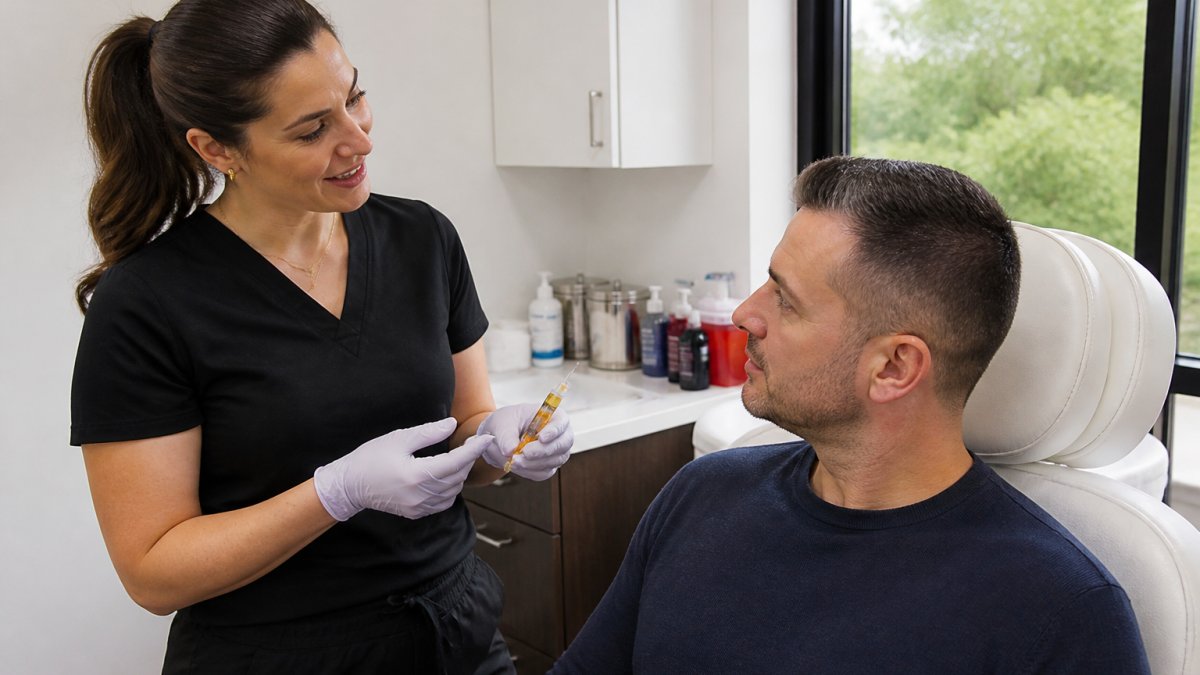
The primary appeal of PRP hair restoration lies in its non-surgical nature and use of autologous material, from your own body. Many patients explore PRP as an early intervention or a complement to other treatments.
Reducing Hair Shedding and Loss
One commonly reported benefit is reduced hair shedding. Patients often notice the rate of hair loss slows within weeks to months after treatment begins.
Growth factors help stabilize the hair cycle. Hair naturally cycles through growth, transition, and resting phases; when follicles linger in the resting phase, shedding increases and hair appears thinner. PRP may shift this balance toward active growth.
Improving Hair Density and Thickness
Beyond reducing shedding, many patients report improvements in hair density and shaft thickness, fewer hairs falling out, and the remaining hair appearing fuller and stronger. The change is gradual, developing over several months as new growth cycles complete.
Supporting Natural Hair Growth
PRP hair restoration supports the body's own regenerative mechanisms rather than replacing hair through surgical grafting or relying on pharmaceuticals alone.
Results also tend to look and feel natural.
PRP Hair Treatment Results: What Research Shows
Clinical evidence for PRP hair restoration is more nuanced than marketing suggests. A fair reading of the literature shows PRP can produce measurable improvements in some patients, but outcomes vary widely and evidence quality differs across studies, depending on research design, PRP preparation, and what "improvement" means in a given trial.
Why Study Results Disagree
Three factors explain most of the variation in published findings:
Protocol differences. There is no standardized PRP preparation method. Clinics use different centrifugation speeds and durations, activation methods, platelet concentrations, and injection depths and volumes. A study using one protocol may not be comparable to another, even if both are described as "PRP for hair loss."
Patient selection. Trials enroll different proportions of men and women, ages, hair-loss stages, and underlying causes. PRP may perform differently in early androgenetic alopecia versus long-standing baldness, and pooling these groups can obscure real effects.
Outcome measurement. Some studies count hairs in a fixed area under magnification; others rely on patient satisfaction surveys or investigator global assessment. Hair counts and patient-reported outcomes do not always move together, and a statistically significant change in hair count may or may not be noticeable in the mirror.
What the Evidence Suggests in Practical Terms
Across randomized and controlled studies, a common pattern is modest improvement in hair density and shaft diameter versus baseline or placebo, most consistent in early-to-moderate androgenetic alopecia. Many improvements are statistically significant but small in absolute terms, a few more hairs per square centimeter or a fractional change in shaft thickness.
A reasonable interpretation: PRP is not a cure for pattern baldness and does not reliably regrow hair in completely bald areas. It may slow shedding and modestly improve thickness where follicles are still active. Responders often notice changes gradually over three to six months, after a series of sessions.
How to Track Your Own Results Objectively
Because individual response varies, general impressions can mislead. Establish baseline measurements before treatment and repeat them at consistent intervals. Useful measures include:
- Standardized photographs taken under the same lighting, angle, and hair length at each visit.
- Hair counts in a marked area of the scalp, often performed with a dermatoscope or trichoscope.
- Shaft diameter measurements to assess whether individual hairs are thickening.
- Shedding counts (for example, hairs collected during washing) to track changes in shedding rate.
Tracking these over six to twelve months gives a clearer picture than waiting to "see how it looks," and helps your provider decide whether to continue, adjust, or stop treatment.
How Many PRP Sessions for Hair Loss
The number of PRP sessions varies with individual response and hair-loss pattern. A common protocol is an initial series of treatments spaced several weeks apart.
After the initial series, many practitioners recommend maintenance sessions to sustain results. Some patients improve after fewer sessions; others benefit from extended protocols. Your practitioner will assess your response and adjust the schedule.
Factors include the extent of hair loss, follicle age, scalp health, and your healing response. Younger patients with early-stage thinning may need fewer sessions than older patients with long-standing loss.
PRP Hair Restoration Side Effects and Safety
PRP hair restoration is generally well-tolerated because it uses autologous material from your own blood.
Because the treatment involves scalp injections, there is a small risk of infection. Some patients experience temporary shedding in the days after treatment as the hair cycle adjusts.
Serious complications are rare. People with certain blood disorders, active infections, or specific medications should discuss their history with their provider first. Pregnancy is typically a reason to postpone treatment.
This safety profile is one reason many people consider PRP before more invasive options.
PRP vs Hair Transplant: Understanding Your Options
PRP hair restoration and hair transplantation address hair loss in fundamentally different ways, and the choice between them, or the decision to combine them, depends on the cause and stage of your hair loss, your goals, and what the evidence actually supports for each approach.
How the Two Approaches Differ
Hair transplantation is a surgical procedure that relocates hair follicles from a donor area (typically the back and sides of the scalp) to thinning or bald areas. Results are generally visible and durable, though the procedure involves recovery time, surgical risks, and a significant financial commitment.
PRP hair restoration is non-surgical. It uses concentrated growth factors from your own blood, injected into the scalp to stimulate existing follicles. There is no downtime. However, PRP does not create new follicles, it can only support follicles that are still present and capable of responding. Results are variable, gradual, and require maintenance sessions to sustain.
Combining PRP With Established Treatments
A common and often more realistic approach is to combine PRP with other treatments rather than choosing one exclusively. The evidence for combination therapy is still developing, but several patterns are worth understanding:
PRP plus minoxidil or finasteride. These medications are established treatments for androgenetic alopecia with their own evidence base. Some practitioners use PRP as an adjunct to medication, particularly for patients who want to maximize non-surgical options or who have had a partial response to medication alone. The claim that PRP adds meaningful benefit beyond medication is plausible but not firmly established.
PRP before or after transplantation. Some surgeons use PRP during or after hair transplant surgery, with the rationale that growth factors may support graft survival and healing. Evidence for improved graft take is mixed. PRP is not a substitute for transplantation in areas of complete baldness, where follicles are absent.
PRP as a bridge or maintenance strategy. For patients who are not ready for surgery or who want to delay it, PRP may be used to support existing hair. It does not stop the underlying progression of androgenetic alopecia.
Making the Decision
The right choice depends on several factors: the extent and pattern of your hair loss, whether you have sufficient donor hair for transplantation, your timeline for results, your tolerance for surgery, and your budget. Many patients begin with non-surgical options, including PRP and medication, and consider transplantation later if needed. Others with advanced baldness may find transplantation more appropriate from the start.
A consultation that includes a scalp examination, a clear diagnosis of the type of hair loss, and an honest discussion of realistic outcomes is the best starting point.
Is PRP Hair Restoration Right for You
Determining whether PRP hair restoration aligns with your needs requires an honest assessment of your hair loss pattern, your expectations, and your medical history. This is the kind of personalized evaluation that Leon NP Family Health Care, PLLC provides during a consultation.
Ideal Candidates for PRP Treatment
The best candidates for PRP hair restoration are people experiencing early to moderate hair loss or thinning who still have follicles present in affected areas. If you are noticing increased shedding, a widening part, or overall thinning but still have visible hair growth, you may be a good candidate.
Candidates should be in generally good health, have realistic expectations about outcomes, and be willing to commit to multiple treatment sessions and potential maintenance treatments.
Types of Hair Loss That May Respond to PRP
Androgenetic alopecia, the most common form of hair loss in both men and women, is the primary target for PRP therapy. Pattern baldness involves follicle miniaturization, where follicles shrink and produce thinner, shorter hairs.
Diffuse telogen effluvium, a condition where hair enters the resting phase prematurely due to stress, illness, medication, or hormonal changes, may also respond to PRP.
Postpartum hair loss and stress-related shedding are forms of telogen effluvium that sometimes respond well to PRP.
| Hair Loss Type | PRP Response | Best Approach |
|---|---|---|
| Androgenetic alopecia (pattern baldness) | Often positive | PRP alone or combined with other treatments |
| Telogen effluvium (stress, postpartum, medication) | Variable | PRP plus addressing underlying cause |
| Alopecia areata (autoimmune) | Limited | Typically requires different treatment |
| Complete baldness with no follicles | Not suitable | Hair transplantation more appropriate |
Hair restoration decisions deserve careful consideration and professional guidance.
Frequently Asked Questions
Does PRP actually work to regrow hair?
PRP hair restoration shows promise for reducing hair shedding and improving hair thickness and density in some patients. Clinical studies have demonstrated that platelet-rich plasma can stimulate hair follicles and support natural hair growth. However, results vary between individuals based on factors like the extent of hair loss, age, and overall health. A consultation with a qualified healthcare provider can help determine whether PRP is likely to be effective for your specific situation.
How many PRP sessions for hair loss are typically needed?
Most patients benefit from an initial series of PRP sessions, followed by maintenance treatments. The exact number depends on your hair loss pattern, the severity of thinning, and how your follicles respond to treatment. Your provider will create a personalized treatment plan during your evaluation. Many patients see gradual improvement over several months as hair regrowth cycles progress.
What are the potential side effects of PRP hair restoration?
PRP hair restoration is generally well-tolerated since it uses your own blood plasma, minimizing rejection risk. Some patients experience mild scalp tenderness, temporary redness, or minor swelling at injection sites. These effects typically resolve. Serious complications are rare. Your healthcare provider will discuss all potential risks during your consultation and provide aftercare instructions to support healing.
How is PRP hair restoration different from a hair transplant?
PRP hair restoration stimulates existing hair follicles to improve growth and reduce shedding, while a hair transplant involves moving hair-bearing tissue from one area to another. PRP is non-surgical and requires no downtime, whereas transplants involve a surgical procedure and recovery. PRP works best for early to moderate hair loss, while transplants may be better for advanced baldness. Many patients combine both approaches for optimal results.